

I want to share something special today for JoeBlogs readers … it’s an excerpt from Mike Schur and my book BIG FAN. It’s a baseball story, one of my all-time favorite baseball stories, and I got special permission to rerun it here. I hope you’ll like it.
Before we get there — we don’t do sales often here, but we are having a Clubhouse summer sale: 20% off a JoeBlogs Clubhouse membership, which includes all the fun stuff we do here, a chance to be a bigger part of our JoeBlogs community, and a free subscription to The Joy of Baseball podcast that Molly Knight and I will be starting up on August 11.
What makes me particularly excited to offer this now is that I think we have stumbled upon a pretty great new series for JoeBlogs — the Rabbit Hole Request series, where Clubhouse members get to send me down whatever crazy rabbit hole they like. This began when Brilliant Reader Lou sent me chasing after a bikini contest in Cleveland in 1977 where the grand prize was a date with my baseball hero, Duane Kuiper.
I wrote about the contest on Wednesday, which was a blast, and then I actually talked to Duane for a piece on Thursday, which was even more of a blast.
A few thoughts from Brilliant Readers:
Brilliant Reader Wogggs: “This is one of the best things ever written in the history of American literature.”
Brilliant Reader Jason: “This whole story has been epic. Very glad to be a member of the clubhouse.”
Brilliant Reader Geoff: “I was really hoping there would be a Part II. Dreams do come true in The Clubhouse!”
Brilliant Reader John: “An absolute joy and looking forward to more Rabbit Hole pieces.”
Anyway, we’d love to have you in the Clubhouse with us. The sale will be going on until midnight on Sunday.
One of the difficulties of promoting a book is that you can never fully explain all that’s in it. I mean, BIG FAN is 426 pages of our blood and heart and soul and funny bones, and there’s no way to get that across on even a long-form podcast, much less a five-minute television or radio hit. So we have spent most of our time talking about our glorious time at the World Darts Championship or how much I hate pickleball or Mike’s experience at Wrestlemania. And sure, we love that stuff. But that’s not the whole book. That’s not even five percent of the whole book.
I wrote this story on the veranda of the Otesaga Hotel in Cooperstown on a cold winter day — I bundled up close to one of their outdoor heaters. I needed to be surrounded by baseball as I wrote …
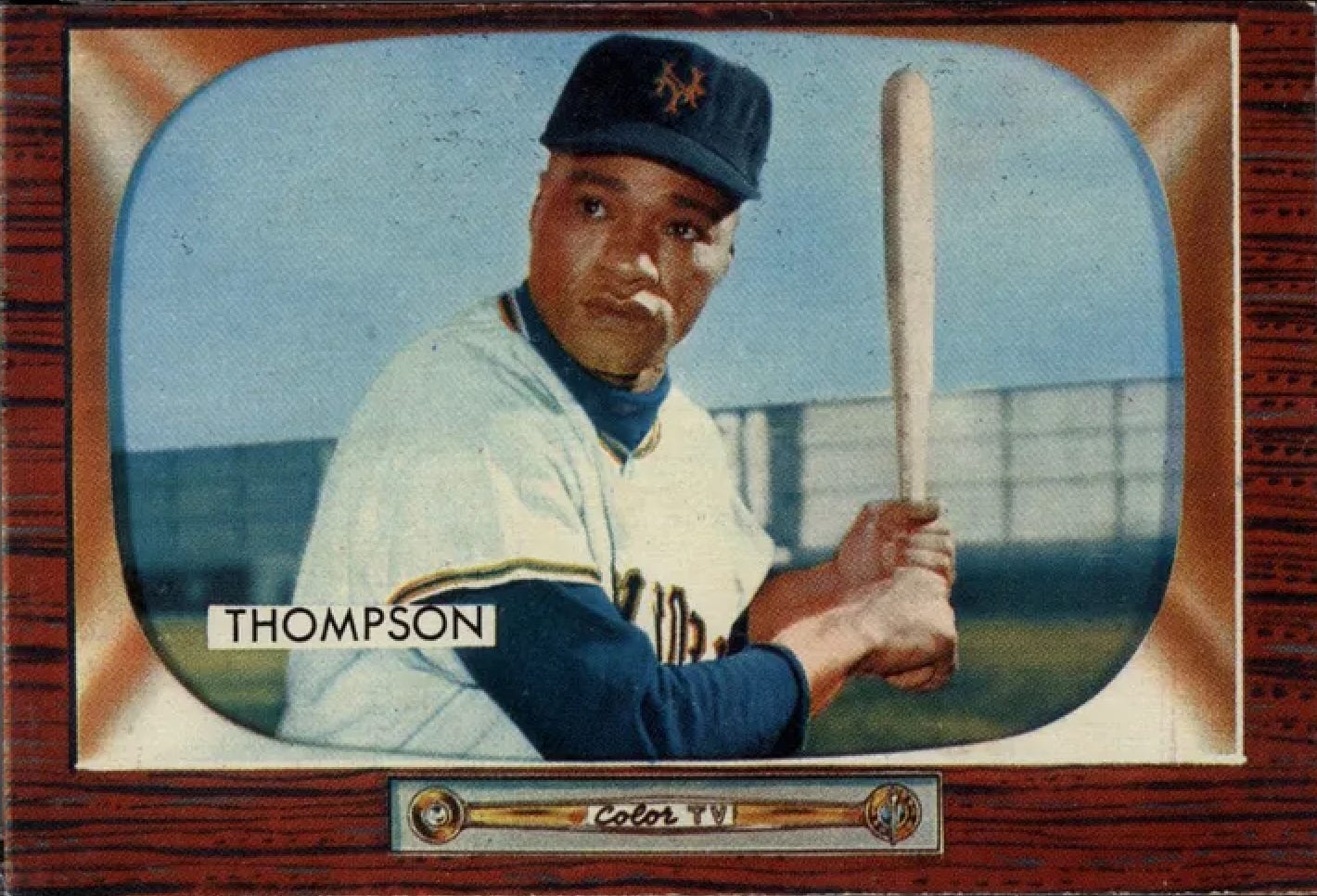
Part 1: Hank Thompson
Henry Curtis Thompson was a lost soul.
Headline: Hank Thompson Accused in Holdup of Harlem Bar
He killed a man.
Headline: Liquor, Golddiggers Led Hank Thompson to Prison
He was arrested too many times to count.
Headline: Thompson Admits Belting Woman, But Denies $3 Theft
He drank himself to an untimely death.
Headline: Hank Thompson Beaten by Cabbie
When the history of baseball gets told, Hank Thompson’s name is left out. Baseball — like America itself — likes its history neat. Uncomplicated. When talking about the integration of baseball, it’s easier to celebrate Jackie Robinson Day annually and move on to the next bobblehead giveaway, the next Shohei home run, the next viewing of Field of Dreams.
But you cannot actually tell the full story of baseball without Hank Thompson, a wildly gifted and troubled man who played baseball like a dream and lived life like a nightmare.
“Don’t ask me to blame society,” he wrote. “Or the fact I’m a Negro in a white world. Or the fact I have a grade school education. I’m the one who kicked society in the teeth.
“Baseball,” he added, “was the only thing I’ve ever done well.”
Jackie Robinson, as you know from history classes and books and the movies, was the first African American to play in modern Major League Baseball. If you are a baseball fan of some note, you will know that Larry Doby was the second.
They both have statues.
Hank Thompson was third.
He was twenty-one years old when an old team called the St. Louis Browns signed him to play second base. He was an old twenty-one. He was arrested for the first time when he was eleven. He joined his first baseball team while he was in reform school. A few months after he turned eighteen, he was drafted into the Army. He went AWOL for a couple of days. He ended up in the stockade after a drunken fight. He served as a machine gunner for two years, including three brutal days during the Battle of the Bulge; in later years, when he played in Cuba, fans would call him Ametralladora— Machine Gun.
In the United States, he would go by “Youngblood.”
When the war ended, Thompson joined the Kansas City Monarchs in the Negro Leagues. America was changing. The Brooklyn Dodgers had signed Jackie Robinson to play in the minor leagues, and the Black newspapers were buzzing about the possibility of an African American finally crossing baseball’s color line. Thompson did not see himself as a candidate. When they told him to pack his bags because he was heading to the big leagues, he laughed and said, “Sure. Just let me finish breakfast.”
But it was true— the Browns were a dreadful team in desperate need of attention‑ grabbing headlines; they hoped that Thompson (and his Kansas City Monarchs teammate Willard Brown) would draw at least a few of St. Louis’s Black fans away from the crosstown Cardinals. The experiment failed miserably. Attendance went down, not up. Thompson played with the Browns for just thirty‑ six days, and they were mostly awful. Every time he walked into the clubhouse to dress, three of his teammates would stand up and walk out, one always saying, “When you finish, we’ll come back.”
He went back to the Monarchs, where in 1948 he led the Negro Leagues in stolen bases and runs scored. When Hank Thompson was right, he did everything a baseball player could do. He could run and hit with power and play every position. That was also the year he shot and killed a knife‑ wielding man in a Dallas bar.
“I remember I was thinking I had no choice,” he would later write. “I know better today. I had two other choices. I could have turned and run, or I could have let him cut my throat. Either one would have been better.”
After the season, the New York Giants— a major‑league team much more respected than the Browns— signed him, and after a couple of months in the minor leagues, he became the first African American to play for the Giants. That makes Hank Thompson the only man to integrate two major-league teams.
He was a good player for the Giants. He set a major‑league record for most double plays started by a third baseman. In the 1954 World Series, he walked seven times—still a record for a four-game series. But he drank himself out of the game. When he was thirty, the Giants gave up on him. And he gave up on himself. It was just too hard.
The last dozen years of his life were filled with pain. When he died, his obituary in the New York papers was three paragraphs long.
“If I could go back and start over,” he told a reporter shortly before his death, “I wouldn’t change the baseball part of my life at all.”
“And the rest?” the reporter asked. “What would you tell a young player?”
“I’d tell them to live a clean life. Stay away from those good‑time people who pretend to be your friends. Stay away from the liquor. And remember: Baseball is the cleanest sport we have. Treat it decent.”
Part 2: The Dad
Matthew Mutton never felt fully at home as a 1990s child in the north of England. All his friends in Manchester played football night and day and rooted with all their hearts for the local heroes at Manchester United, and though he couldn’t quite explain it, that just didn’t quite work for him. He wasn’t very good at soccer. He was drawn to soccer teams other than United. He felt just a little bit uneasy as if he longed for something else.
Then one day, he was watching one of his favorite cartoons— The Real Ghostbusters— and something utterly unexpected and wonderful happened. Ghostbusters character Winston1 went to a baseball game.
Matthew had never heard of baseball; he had no idea about the rules or the players or even what it looked like in real life. But he liked Winston, and when he saw Winston drafted to play against a team representing evil2 and saw him hit the big home run that defeated evil, he felt himself buzzing.
“I thought, ‘WHAT THE HECK IS THIS GAME AND CAN I PLAY IT?’ ” he says.
He could not play it, not in Manchester. Nobody played baseball. Literally nobody. He’d never met anyone who even had a vague idea about the rules. But being a kid of his time, he did have a Commodore Amiga computer. Today, greeting cards have more RAM than the Amiga, but it felt revolutionary then, especially when the game RBI Baseball 2 was released in 1991. It was the first console game that used actual baseball names, and Matthew got hooked. He loved the Athletics because they wore green. Soon, he was teaching kids in the neighborhood how to play baseball, which was quite funny because he did not know how to play. But he found a bat at a seaside resort in the UK and pulled some balls and gloves from a Toss and Catch Beach Toy set. When he got into a snowball fight, he noticed one kid who threw harder than the rest, and he asked, “How did you learn to throw like that?”
The kid said: “I play baseball.”
“WHERE?” Matthew shouted, and the kid said there was a team up the road in Bolton, and Matthew pleaded with his parents to get him a real ball and glove for Christmas. He didn’t get it, but he couldn’t stop thinking about this weird and wonderful game.
And then, when he was in high school, the strangest and most remarkable thing happened. He turned on the television— in the UK, in Manchester, in his living room— and there, in brilliant color, was . . .
Major League Baseball?
Part 3: MLB on Five
On March 30, 1997, the Spice Girls sang the countdown, and Channel 5 launched with a promise to shake up British TV. There had only ever been four channels. This one was for the weird kids. This one was for the night owls.
This one was for the sports fans who wanted something more.
The next day — after midnight — Channel 5 launched the first edition of Live and Dangerous, a show meant to feature live overnight broadcasts of American sports. That first show featured a game between the New York Yankees and the Seattle Mariners.
And Matthew Mutton was watching.
“Ken Griffey Jr.!” he says. “He was all over the adverts, and when I saw them, I thought, ‘OK, that’s my guy!’
Live and Dangerous evolved quickly. The show went away from the danger branding — “danger” is not the first word you think of when thinking about baseball — and dropped the pretense that they were going to show other sports. They renamed the thing MLB on Five.
Channel 5 was all in on baseball.
The best part? Nobody at Channel 5 knew a thing about baseball.
The original host, a veteran presenter named Tommy Boyd, was not only baffled by the game; he couldn’t even pretend to like it. One day, he called in sick and never returned.
The show went on. A Canadian baseball fan named Erik Janssen called into the station one day to complain about the countless errors the graphics department was making and the egregious spelling errors he saw every day . . . and the station manager immediately hired him.
A year later, he was producing the show. Another longtime television presenter named Jonny Gould became host, and while he didn’t know too much about baseball either, he brought a joyful and passionate love of the sport.
“Hello, fellow baseball nuts!” he would begin each broadcast.
And then there was Josh Chetwynd, who was born in London, grew up in Los Angeles, played college baseball at Northwestern, kicked around as a pro‑ baseball player, played a bit for Team Great Britain, and then became the color commentator for MLB on Five. It was Erik and Jonny and Josh who brought baseball to the outsiders, the folks like Matthew who just didn’t quite feel fulfilled by the array of sports in the UK and longed for something a little more and a little different.
“Every baseball fan in the UK has some story about MLB on Five,” says our pal Matt Drew, who may not be, or may be, the only Padres fan in London, but he is surely the most passionate— partly because a seven ten p.m. start on the American West Coast is a three ten a.m. start in London.
“Everybody can tell you about staying up too late to see the end of the game and then rushing to work without showering and without sleep. There may not be too many baseball fans here,” he says. “But the fans here have to work hard at it. The fans here are real fans.”
Part 4: The Show
When Bob Kendrick, president of the Negro Leagues Baseball Museum, was approached by Sony to feature Negro Leagues players in the video game MLB: The Show . . . well, he didn’t think much about it.
Obviously, he said yes. Bob says yes to anything and everything that helps spread the story. He accepts just about every speaking invitation. He puts his heart into every promotion. He spreads the gospel.
See, Bob is the disciple of Buck O’Neil, the great Negro Leagues player, manager, and spokesman who spent the better part of his life keeping alive the memories of those players who were denied the chance to play in the so‑ called big leagues because of the color of their skin.
“We could play, man,” Buck used to say, and Bob was always by his side.
“Every day,” he says, “I think about living up to the example of Buck.”
So, yes, he was happy to work with Sony on the game. But . . . he didn’t get it. He’ll tell you now, he absolutely didn’t get it, didn’t realize just how big a deal it was to get Negro Leaguers into that game.
“I knew video games were big,” he says. “But I really didn’t know.”
Sony told him they wanted to put eight Negro Leagues players into the game, but they didn’t want them to be the eight best or most obvious players. Bob tried to put together a good blend of players, some famous, some unknown.
Jackie Robinson— well, he obviously needed to be in the first year. He played for the Kansas City Monarchs in 1945, and that was what led directly to him getting signed by the Brooklyn Dodgers. That one was easy.
Satchel Paige was easy too. He was not only the greatest pitcher in the history of the Negro Leagues; he was the most magnetic and unforgettable player. There are enough Satchel stories to fill dozens of books, but one of them is that he had different names for his pitches. While others called their pitches fastball and curveball and changeup, Satchel called his pitches Jump Ball, Wobbly Ball, Long Tom, Short Tom, Whipsy‑ Dipsy Do, Bat Dodger, Midnight Creeper, Nothin’ Ball, Two Humper, Radio Ball, and, most famously, the Be Ball.
“Why do you call it the Bee Ball?” he was asked on the premise that maybe it buzzed like the insect. That wasn’t it.
“Because,” Satchel said, “it BE where I want it to BE when I want it to BE there.”
Bob thought Rube Foster had to be in the first group because he was not only a great pitcher; he founded the Negro Leagues.
Bob wanted a Spanish-speaking player — the Negro Leagues was a haven for dark-skinned Latinos. That choice was obvious too: It had to be Martín Dihigo, “El Maestro,” who played all nine positions and was as skilled a hitter as he was a pitcher.
And, naturally, Bob was going to include his mentor, Buck O’Neil.
That left three players, and Bob wanted each of them to tell a forgotten story.
He chose John Donaldson, an early‑ twentieth‑ century pitcher who was, in many ways, Satchel Paige before Satchel Paige. His name was all but lost to history until a group of fans decided to scour the archives of their local libraries to find news stories and box scores about him. They have, so far, uncovered four hundred twenty‑ eight Donaldson victories and more than five thousand strikeouts. The Donaldson Network fans (as they call themselves) keep searching for more.
Bob also chose Hilton Smith, a brilliant right‑handed pitcher who was often known in his time as “Satchel’s Relief.” Because Satchel was by far the league’s biggest draw, he started nearly every single game. He would pitch the first three innings and then give way to Smith, who would usually pitch the last six. Hilton Smith was overshadowed by Satchel Paige in his time (as they all were) but Buck O’Neil would say Smith was every bit as good.
That left one. And Bob Kendrick thought long and hard about who that last one should be. He wanted someone who had been forgotten, a name that would ring few bells among even stout baseball fans, someone whose greatness needed to be reclaimed.
And he knew just the player.
“Guys,” he told the Sony folks, “the eighth player should be Hank Thompson.”
They didn’t know Hank Thompson. Bob explained: He was this extraordinary talent who had integrated two big-league teams. When asked why he wasn’t more famous, Bob talked a bit about the demons that had possessed Hank Thompson.
“We want our heroes to be all hero,” he said. “But that’s not life. That’s not human.”
Part 5: Elliott
Elliott is six years old. He is a sports fan because his dad is a sports fan.
Elliott especially likes baseball. When he was two, his dad took him to his first baseball game— featuring the Manchester Baseball Club. Matthew Mutton and his son, Elliott, have been to loads of Manchester Baseball Club games in the years since. Matthew even helps coach the youth team. He also started the British Baseball Podcast to talk about baseball across the UK.
On one of his first podcasts, he got Jonny Gould, Josh Chetwynd, and Erik Janssen to answer some listener questions. “It was like a dream,” he says.
Elliott likes playing baseball, but like his dad, he particularly likes playing video games. Baseball video games have come a long way from RBI Baseball 2 on the old Commodore Amiga. This is particularly true of Elliott’s favorite game: MLB: The Show. The action looks startlingly real. The players are so lifelike you want to ask them for autographs.
In 2023, Elliott and Matthew got MLB: The Show . . . and were delighted to find that there were Negro Leagues players in it. Matthew had long had a fascination with the Negro Leagues, and he had told Elliott the stories of Josh Gibson and Oscar Charleston and Smokey Joe Williams and so many remarkable players who never got the chance to play in the major leagues. Elliott was transfixed.
So when Elliott saw the chance to actually PLAY with these players, it just about blew his mind. He played with them all. He watched all the little movies about them— each narrated by Bob Kendrick. And there was one player he particularly loved, an outfielder who could hit with power and run like the wind.
“Dad,” he said one day, “I have a favorite baseball player.”
“Who’s that?” Matthew asked.
“My favorite‑ever baseball player,” Elliott said, “is Hank Thompson.”
Winston on The Real Ghostbusters was voiced by comedian and future talk show star Arsenio Hall.
One of the wonderful things about this episode, called “Night Game” is that when the Ghostbusters complain that the Team of Evil is cheating and the game should be forfeited, the umpire simply says, “But evil cheats. That’s its nature. It does whatever unscrupulous or immoral thing it has to to win. That’s why we call them ‘evil.’
Thanks for posting this piece. I have the book but haven't had a chance to start reading it yet.
My wife, Katie, passed on June 19th after a long battle with metastatic breast cancer. Finding any joy over the last month has been extremely difficult. Rather, I find myself riding waves of complete numbness interspersed with crushing grief. But this piece brought a little bit of joy into my morning.
Thank you.
And I am not sure if this is allowed or even prudent, but here is a link to her obituary. She was a great person whose story deserves to be known. Hopefully, some of her light can carry on through others.
https://everloved.com/life-of/katherine-vicars-soloway/obituary/
I, honestly, have no idea what my subscription to JoeBlogs costs. It just hits my credit card. But, whatever it costs, it's a bargain. Reading these have brought back so many childhood memories for me. My father is 87 and I can't count the number of times I have read something here and it made me want to call my dad. Thanks Joe.