

Happy Monday, everybody. I ramble a bit this morning about batting averages and the difficulty of winning a golf major vs. a tennis grand slam. I’m very close now to finishing my final numbered chapter on SEASONS — my countdown of the individual baseball seasons that echo the loudest!
There’s still quite a bit to do because there will be several unnumbered chapters that I’m excited about. But I’m writing my No. 1 season right now, and when I finish that (hopefully today!): Yeah, I’ll be feeling pretty good.
The ABS Challenge Scorecard
Total challenges: 932. Challenges have been successful 506 times (54%).
Batter challenges have been successful 47% of the time.
Fielder challenges (almost always catchers) have been successful 61% of the time.
We are starting to see some real day-to-day consistency in the challenge percentages. Over the weekend, batters got a little less than 45% of their challenges right. And catchers got 62% of their challenges right. It’s still SO early in the season, but we’re using this challenge scorecard to see if we can spot any early trends, and it seems to me that the challenge system might help pitchers more than it helps hitters.
It’s a bit of a mixed bag, but here’s what we’re seeing compared to last March/April.
Batting average and slugging percentage are down.
Home runs are noticeably down.
Strikeouts are up somewhat.
Walks are WAY up, though.
We’re going to talk about our pal Tom Tango and his never-ending fight with batting average in a minute, but to whet the appetite, it’s worth mentioning that overall runs, so far, are NOT down. That anemic 375 slugging percentage — which, if it holds up, would be the second lowest for any April in 34 years — is offset by what would be the highest walk rate in baseball history.
Maybe you’ll find this chart interesting, maybe you won’t:
Batter’s performances in April:
2026: .235 average, .375 slugging, 3.8 walks, 0.94 HR, 4.34 runs
2025: .242 average, .392 slugging, 3.4 walks, 1.06 HR, 4.34 runs
2024: .240 average, .385 slugging, 3.3 walks, 1.01 HR, 4.38 runs
2023: .247 average, .407 slugging, 3.3 walks, 1.13 HR, 4.59 runs
2022: .231 average, .369 slugging, 3.3 walks, 0.90 HR, 4.03 runs
It’s especially interesting to me to compare 2022 and 2026 because the core numbers are similar, but because hitters are walking so much more, they’re scoring quite a few more runs.
No matter how much we talk about the importance of walks, I suspect we still underplay the value.
In fact … let’s get into that with Tom Tango.
Tango’s Forever War
If you’ve been following this space for a while now, you know that my great pal Tom Tango has no use for batting average. I don’t mean that loosely; he truly believes that batting average does nothing but deceive fans when they’re trying to evaluate a hitter’s value.
His now famous example is this: Take two players —
Player 1: .315/.365/.510
Player 2: .260/.365/.510
Now ask yourself: Which player is more valuable?
We’ve written about the Tango Conundrum before, but he just put the example back up on social media to see if fans have made any progress on understanding. And, to his dismay, it seems like fans have gone BACKWARD in their understanding.
This time, he found that:
Fifty-nine percent of fans calculated that Player 1 is clearly more valuable.
Eleven percent of fans calculated that Player 2 is clearly more valuable.
Twenty-one percent of fans decided that it was too close to call.
Before I tell you again what Tango has found the answer to be, we should probably explain why fans are so tempted to say that the player with the much higher batting average must be more valuable: It’s the simple assumption that a single is worth more than a walk. And that assumption is correct. A single, in many instances, IS worth more than a walk. A single can move a runner more than one base. A single can advance (or score) a runner on second or third (or both). There also might be some hidden value to singles over walks that we can’t calculate. I’ll leave that to you.
A single is worth more than a walk — so all other things being equal, the higher batting average MUST be more valuable, right?
Of course, that’s not how this math works — all things are NOT equal. And this is why a sizable percentage of fans calculated that the LOWER batting average must be more valuable. See, if there’s a big difference in batting average but their slugging percentages are the same, that means the lower-average hitter has more extra-base hits. Nobody would argue against a double being worth more than a single or a home run is worth more than a double.
Here’s a real-life example:
In 2004, Ivan Rodriguez hit .334 and slugged .510. He hit 123 singles, 32 doubles, 2 triples, and 19 homers.
In 2019, Bryce Harper hit .260 and slugged .510. He hit 77 singles, 36 doubles, 1 triple, and 35 home runs.
Pudge had 46 more singles and an extra triple. That’s 49 more bases. But Harper had four more doubles and 16 more home runs. That’s 72 more bases. Harper did get about 50 more at-bats that year, but I’m not actually comparing Pudge and Harper (Harper’s year was much better offensively because he walked 99 times to Pudge’s 41), I’m just reiterating how the math works.
So you have one side betting on singles being worth more than walks.
And you have one side betting on those extra base hits being worth more.
But Tango’s point is that the whole argument is wrong. His point is that the walks and extra base hits basically cancel each other out. His point, again, is that batting average is pointless, that including it in the slash line doesn’t add anything at all.
Instead of having one player with a .315/.365/.510 line and one with a .260/.365/.510 line, Tango believes that when it comes to evaluating hitters, you only need .365/.510. The batting average is not just excess; it clouds analysis.
I’ve been telling Tom for years that it's a losing battle; that batting average is too big a part of baseball’s history and American culture. Way back in the 19th century, the Father of Baseball — Henry Chadwick — decided he HATED walks, believed them to be the fault of sloppy pitchers, and determined they should not be included in batting average. He was wrong. But that choice has rippled through baseball for 150 years. Batting average ain’t going anywhere.
Plus, there’s an aesthetic value there. Maybe the two hitters in the Tango Conundrum are worth the same, but that doesn’t mean that we will like them the same. Some will prefer the high average hitter, the Don Mattingly type. Some will prefer the slugger, the Darryl Strawberry type.
But as far as the hitters’ values go? I have little doubt that Tango is right.
What’s harder — a golf major or a tennis grand slam?
I’ve been enjoying the Nothing Major tennis podcast featuring the last generation of American tennis stars — Sam Querrey, Jack Sock, John Isner and Stevie Johnson — and the other day they tried to answer the classic listener’s question:
What’s harder to win: A golf major or a tennis grand slam event?
I love this question and have thought about it many, many times. I will start by telling you that the quartet unanimously agreed that a tennis slam is significantly harder to win, and I totally get why they said that: none of them has won a major. I do not mean that cruelly; that’s the title of their podcast.
And I think that in the context of Querrey/Sock/Isner/Johnson, they are totally right. I mean, all four of them were FANTASTIC players. Utterly fantastic.
Johnson moved beautifully on a court, won four titles, and topped out at No. 21 in the world.
Querrey had a huge serve, a big forehand, won 10 titles, beat Andy Murray at Wimbledon, and he topped out at No. 11 in the world.
Jack Sock had a forehand that defied description, won four titles including the prestigious Paris Masters, was a doubles champion at Wimbledon, the U.S. Open and the Olympics, and topped out at No. 8 in the world.
John Isner might have had the greatest serve in tennis history. He won 16 titles, reached the semifinals at Wimbledon, twice made the quarters at the U.S. Open, and topped out at No. 8 in the world.
I feel quite certain players THAT accomplished in golf would have won a golf major. I think if you see the question as: “What is harder for a top 25 player to win?” the answer is definitely and obviously tennis.
Just last year, J.J. Spaun, who was ranked 25th in the world, won the U.S. Open.
That’s fairly common in golf.
No player ranked 25 in the world has won a tennis slam since, yikes, I don’t even know — maybe Gáston Claudio in 2004 when he won the French Open? Tennis used to have these sorts of surprise winners now and again, but ever since Federer/Nadal/Djokovic (and now Sinner/Alcaraz) well, as Ferrari says in Casablanca, “it would take a miracle and the Big Three outlawed miracles.”
So, from that perspective, absolutely, the Nothing Major guys got it just right.
But what about from the perspective of the very, very best players on earth? That is to say: The PGA Championship and French Open are coming up in the next few weeks. The top five golfers in the world, as I write this, are:
Scottie Scheffler
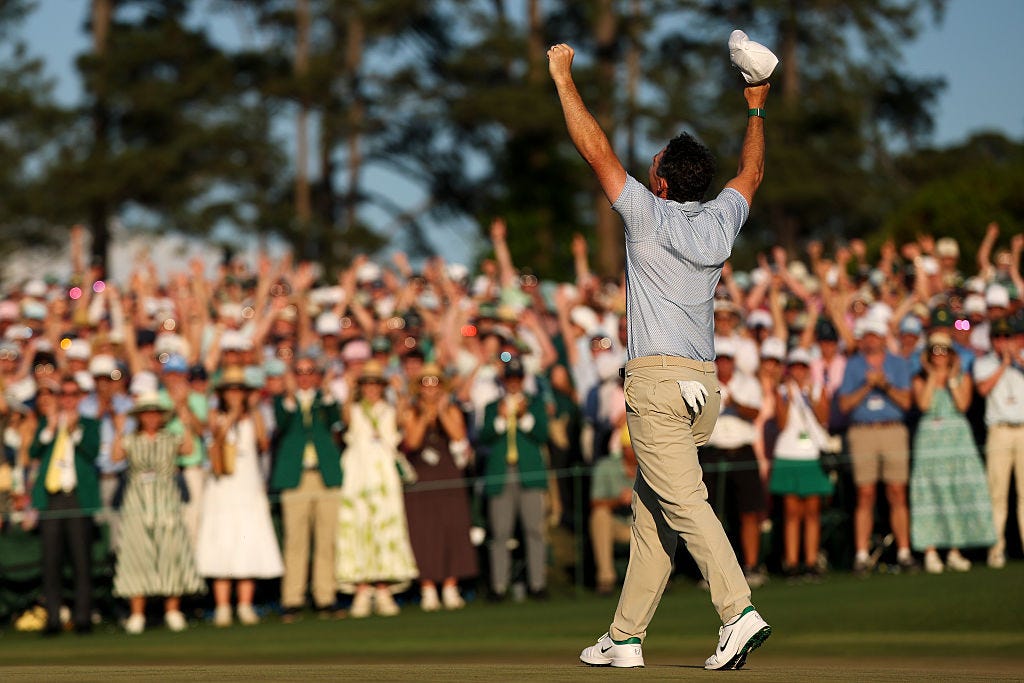
Rory McIlroy (congrats to Rory for another green jacket!)
Cameron Young
Justin Rose
Tommy Fleetwood
And the top five tennis players in the world, as I write this, are:
Jannik Sinnner (just overtook Alcaraz by winning in Monte Carlo — he looks unstoppable)
Carlos Alcaraz
Alexander Zverev
Novak Djokovic
Felix Auger-Aliassime
Now, you tell me — if you had to bet on the next major winner coming from the top five, would you bet on the golfers or the tennis players? It’s not even close.
Or, even more to the point, would you bet on Scheffler/McIlroy or Sinner/Alcaraz?
There’s no question. Scheffler/McIlroy certainly could win the PGA Championship. I’d put their chances, though, no higher than, what, 25%? Lower? There’s a reasonable chance neither one will even contend because that’s how golf works.
The chances Sinner or Alcaraz win the French Open? I mean, the way those two guys are playing, the gap they’ve put between themselves and the rest of the world, that’s probably 90%. It’s pretty close to an even-money bet that they face each other in the final again — like they did in last year’s French Open, and also last year’s Wimbledon, and also last year’s U.S. Open.
Yes, it’s much harder for a good player to win a tennis slam because to do it, you have to beat the very best tennis players on earth one-on-one. You’re not playing the course. You don’t have four days to round your game into shape (Scottie Scheffler barely made the cut at the Masters, and he almost won the thing anyway). You have to start over each time you play.
But I’ll bet if you asked McIlroy or Djokovic which is easier, they’d both tell you winning a tennis slam is easier.
Batting average is only irrelevant if you believe baseball stats should be solely used to determine player value. That is one way to use stats, the other is to describe what has happened with numbers. Batting average is like pitcher wins or runs scored or home run totals, they give you a picture of what kind of player a person was and what happened in their games. That has tremendous value to a fan.
According to Mike Hegan in Ball Four, the hardest thing in sports is explaining to your wife why *she* needs a penicillin shot for *your* kidney infection.