


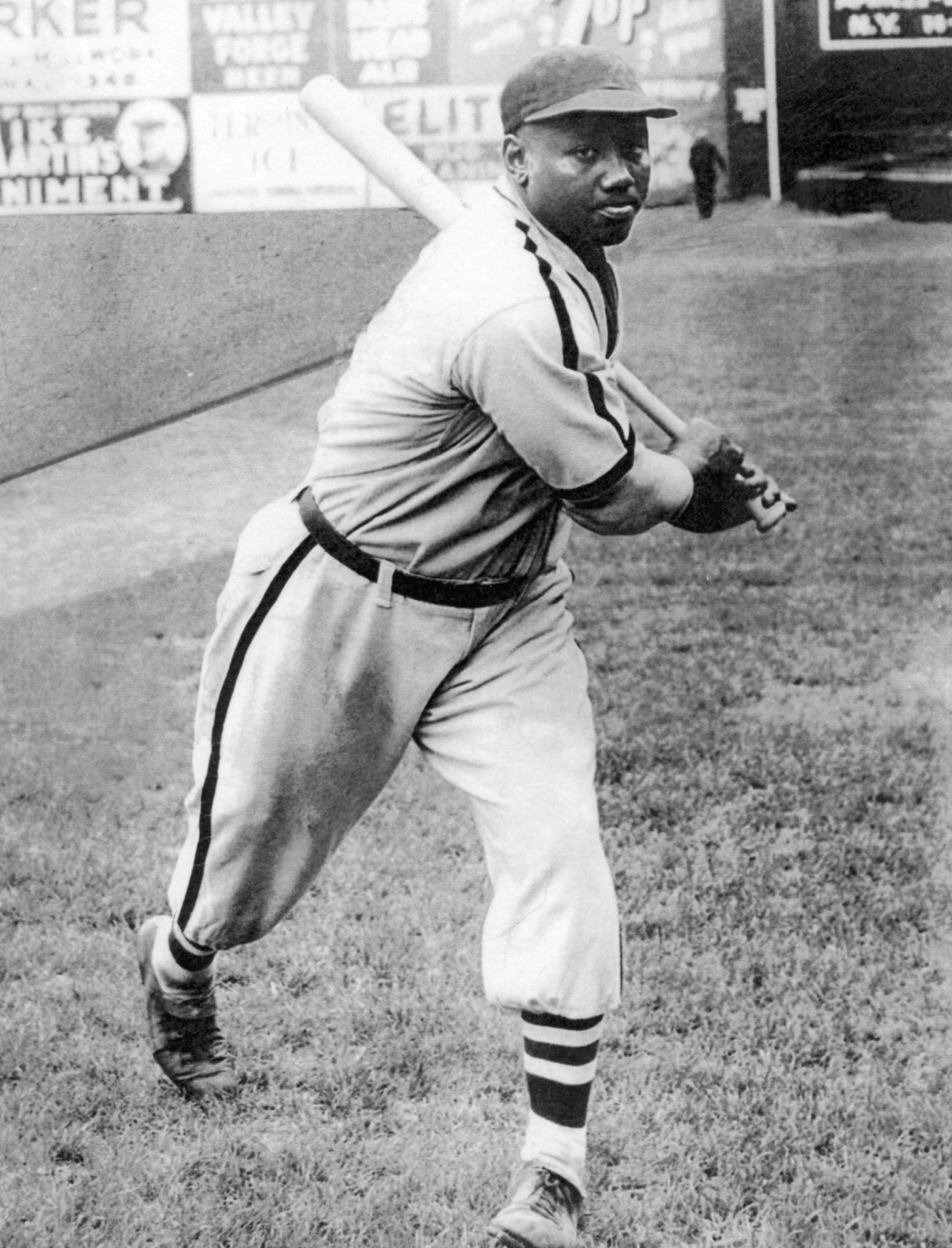
Many of you have asked me to comment on MLB’s decision to incorporate Negro leagues stats into the official major league record. Back when MLB first made this announcement, Bob Kendrick and I wrote about it for Baseball-Reference, and some of what I think today—when Josh Gibson officially becomes the all-time leader in batting average (.372, surpassing Ty Cobb’s .366) and slugging percentage (.718, surpassing Babe Ruth’s .690)—is in that piece.
And, honestly, some of what I think today is not.
My feelings about this are complex. I’m obviously thrilled that Major League Baseball is acknowledging the Negro leagues in this very real way. I’m in awe of the researchers who continue to dig deep into the archives to bring out the living history of baseball. I’m in total agreement with Sean Gibson, Josh’s grandson, that the MVP award should be renamed in “The Josh Gibson Award.”
And I would like to take a moment to applaud, yes, Rob Manfred. We’ve had plenty of disagreements with Manfred through the years, and I’m sure there will be plenty more. But he has done much more than any commissioner in the history of baseball to honor the Negro leagues, done more than any commissioner in the history of baseball to celebrate and respect and even attempt to redress baseball’s glorious but checkered history.
All of that is the easy part.
The harder part is, by its very nature, difficult to put into words. In virtually every interview I’ve done surrounding WHY WE LOVE BASEBALL, I’ve been asked: “So why do you love baseball?” My stock answer is that if I could explain that in a few words, I wouldn’t have had to write an entire book about it. Then we laugh, and the question is asked again, and I give a sound-bite answer about my father teaching me the game or about my love of Duane Kuiper or about collecting baseball cards or something.
But the first answer is the real one for me. Why I love baseball is spread out over 400 passionately written pages. Why I love football is spread out over 400 passionately written pages.
And my deeper feelings about the Negro leagues statistics being added to the record bit by bit like this—my friend John Thorn readily admits that only about 75% of the boxscores have been documented, and this is very much a work in progress—require a much deeper project that encompasses much more than just the Negro leagues stats, something that attempts to get at the heart of history and statistics and greatness and memory and how to keep the past alive.
As it turns out, I have found that project. It began as a small idea inspired by Brilliant Reader Dan, and has mushroomed into this monster. If I do it right, I think it will blow your mind. It blows my mind that I’m even trying it.
Here’s my goal: I’d like to finish the project this week (phew) and then run it in four or five parts next week while I’m off to London. This might even become something that we can turn into a little JoeBlogs book for subscribers.
I don’t want to give anything more away about it except to say that it’s not specifically about the Negro leagues. The Negro leagues play a big part in it, yes, but this one incorporates all of professional baseball history, going back to the 19th century. And if I sound super-excited about it, well, I am, because it’s not often as a writer that you find a vehicle that allows you to put seemingly ineffable thoughts into actual words. I think this one will.

A few quick schedule notes:
I’m in Los Angeles working on a couple things—including this super-intense project I’m hoping to get to you next week—so things will likely be a bit slow for the rest of the week. That is, you know, unless big news breaks, which undoubtedly will happen.
For those of you in the greater Charlotte area, a quick reminder that I’ll be at the Southpark Library this Sunday, June 2, talking WHY WE LOVE BASEBALL.
For those of you who can be in London next week—I’ve been blown away by the response—I’ll be at the Waterstones in Trafalgar Square at 5 p.m. on Friday, June 7, to sign copies of the UK edition of WHY WE LOVE BASEBALL. Then, whoever is interested, can join me at the Theodore Bullfrog pub for some baseball talk and cheer. If you’d like to be there, it would be helpful if you gmailed me so we can get a headcount. But if you decide to join at the last minute, well, everyone is welcome!


I have found that most people who do not like the inclusion of Negro League stats are feeling something primal; they don't want something that they "know" to be erased. Or they will argue about the "officialness" of Major League statistics, and how Negro League stats somehow don't match up, because they weren't as well documented, or the seasons were irregular lengths, or the competition was inconsistent.
Negro League baseball shares all of those features with 19th-century baseball; it's odd that you rarely ever hear people arguing against the inclusion of 19th-century baseball for those same reasons. (I think it IS appropriate to point out that this is what culturally-inherited racism IS; individuals who make these arguments aren't "being racist;" they've inherited a racist system and continue to perpetuate its assumptions, likely unknowingly.)
But MOSTLY, what people object to, is that they want baseball to be something pure, something that is OUTSIDE the complications of real life. They want something that is somehow True-with-a-capital-T. Statistics like WAR muddy the waters, so people don't like them. Adding in Negro League stats muddies the waters, so people don't like that. Steroids muddied the waters, so people reject them and the players of that era, too.
What it is, is a perfectly normal, perfectly reasonable reactionary response to someone saying, "The thing you like is actually really complicated," when part of what you liked ABOUT it was its simplicity.
Unfortunately, things ARE complicated. Life IS hard. Trying to run away from it doesn't serve anyone. It's why religious reactionaries flourish, because people want a philosophy that says that it's all really SIMPLE, rather than being complex. (Please don't @ me about religion; it comes to mind as a potential topic because I'm an ordained pastor who serves a church in a mainline denomination and I literally think about and/or come across this exact type of response almost daily whenever someone tries to introduce complexity to a situation someone would rather continue to take as simple. I'm not criticizing religion in general, just certain flavors of it.)
I understand the reaction. I understand why people have a hard time with it. In 40 years, literally no one will care. That's just what the result of this will ultimately be, because that's always BEEN the result of changes like this. We'll all survive it. And once people get over their initial discomfort, baseball will continue to be a fun game to watch with a rich and entertaining history.
Those stats were not compiled in what anyone at the time -- the Negro Leaguers, themselves -- thought were Major League Baseball games.
The players were great, yes. Many of them deserving HOFers. And I'm glad we have their stats.
But -- and again, this isn't a normative statement -- they're not "real" MLB stats. Not compiled over standard, 154-game seasons, not compiled regularly in general, and not against major league competition.
We can all agree that the color line was an abomination. We can also agree it's a tragedy Gibson and Paige and Charlston and Cool Papa didn't get to compete against Ruth, Cobb, Johnson, & Grove in MLB games. All true, and all sad.
But going back and taking stats compiled in what may have been a AAAA-level league, over seasons of way fewer than 154 games, and stamping them over the template of 125+ years of MLB stats DOES NOT undo any of the injustice.
Statistics should keep track of WHAT ACTUALLY HAPPENED, and not what could/should have happened.
I don't know if Josh Gibson would've batted .372 against MLB pitching over a series of 154-game seasons. What we do know, unfortunately, is that he DID NOT, because he wasn't given the chance. Pretending he did doesn't change the history.