


When Albert Pujols was 16 years old, he moved from the Dominican Republic to Missouri to be with his father and grandmother. He didn’t know more than five words of English, and the woman who was assigned to be his English tutor at Fort Osage High School did not know five words of Spanish.
Pujols did know one thing. Shortly after arriving, he went down to the high school baseball field with his cousin to meet David Fry, his new baseball coach. Fry offered a few dizzying words of welcome and asked a couple of questions.
Pujols did not understand any of those words.
“Tell him,” Pujols said to his cousin in Spanish, “that I’m here to play baseball. Let’s go play. I’m not here to talk about anything.”
Here to play baseball. That’s the Albert Pujols story. His senior year at Fort Osage, he was such a fearsome hitter that managers walked him 55 of the 88 times he stepped to the plate. At Maple Woods Community College, he did not strike out a single time all season. In his first big-league spring training — after being drafted in the 13th round by the Cardinals — he was so absurdly good that manager Tony La Russa was already talking about him going to the Hall of Fame.
Pujols, in those years, was the rarest of forces — he was the best player in baseball and the most underrated player in baseball at exactly the same time. In his first 11 seasons in the big leagues, he finished top five in the MVP voting every single year but one.
But it is the one that defines him. That was 2007. The voters decided he’d had an off-year. He slashed only .327/.429/.568, and he hit only 32 home runs and 38 doubles, and he drove in only 103 runs and the Cardinals finished with a losing record. The voters put him ninth in the MVP balloting that year.
Here’s the best part: Albert Pujols still led the league in WAR in 2007.
Well, of course he did. He always led the league in WAR. Literally. From 2005 through 2010, six straight seasons, he led the league in WAR.
His greatness in those days was both visible and invisible. It’s not like people missed him; you can’t miss a player who hits .325 every year, hits 40 homers every year, drives in 120 runs every year. He won three MVP awards, a couple of Gold Gloves, led the Cardinals to a couple of World Series titles.
And yet, only those who saw Albert Pujols play every day fully understood the staggering depths of his brilliance. He decided after his rookie year to stop striking out (he whiffed 93 times that season). So he stopped striking out. He decided in his mid-20s to improve his defense. So he became one of the great defensive first basemen. He decided that even though he wasn’t blessed with much speed, he should become a dangerous baserunner. Over the next few years, he stole based at roughly an 80% clip.
He was Superman.
When he left St. Louis for all that money in Anaheim, he was on pace to make his case as the greatest baseball player who ever lived. We all know what happened after that — the decline, the injuries, the slowed bat, a decade in the wilderness. People forgot about him. I don’t know how much that hurt. Pujols isn’t one to talk about that.
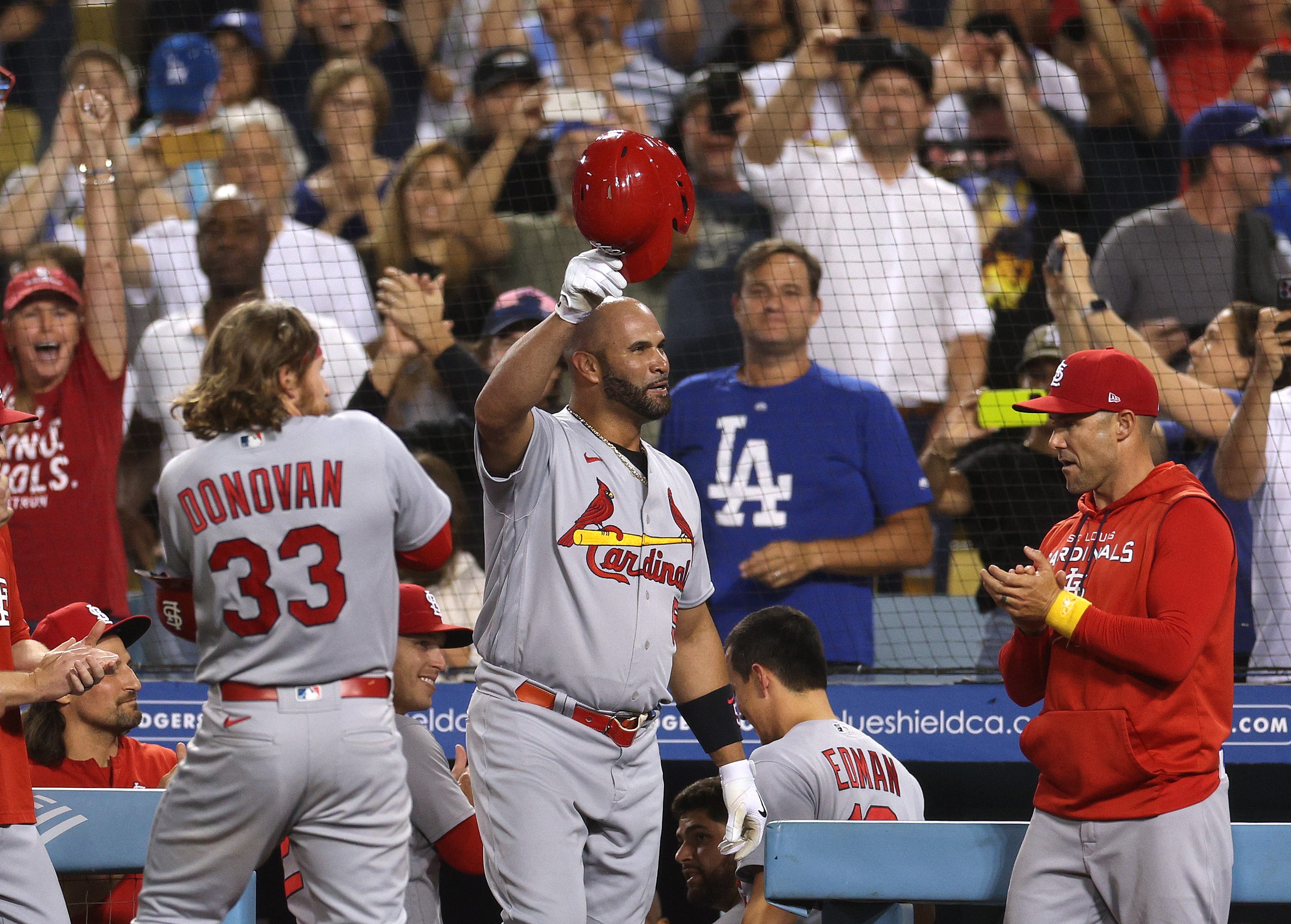
On Friday night, Albert Pujols — back in a Cardinals uniform — turned on a Phil Bickford slider and sent it sailing into the Los Angeles night. It was his second home run of the game and the 21st of this surprising and wonderful season. Mostly, though, it was home run No. 700.
Pujols rounded the bases with his arms in the air, and after he touched home plate and listened to the roar from the crowd, he jogged back into the dugout, disappeared down into the tunnel and cried.
You can understand. On this night, Albert Pujols got to do something so few of the great ones get to do. He got to remind people, one more time, just what he was all about.

Many, many times over the last couple months, I've thought about how Joe ended the Pujols chapter in The Baseball 100*.
"Each year, I hope against hope for Pujols to be Pujols just one more time. Sadly, that just isn't how time works ... He'll never be that player again, no. But maybe he will connect like that one more time. That would be nice. It would be great to say to our kids, 'Yeah, that's Albert Pujols.'"
I know Joe wasn't alone in wishing for that.
And Albert did it. He really did it.
He more than did it.
The last couple months have been an extraordinary gift.
* Joe wrote a book called The Baseball 100, in case you haven't heard.
I saw Pujols one game when he was at community college. I was there to see a young guy that worked at my work play for the other team. He hit the hardest ball I have ever seen in person, before or since, and I played until age 22 and have seen about 250 MLB games. There was a SS playing deep in the hole against him and he hit it so hard it was like one of those line drives back to the pitcher that you are just thankful he wasn't decapitated - only I felt that way about a guy more than twice as far away. It split the outfielders and hit the wall on a hop, never more than about 6 or 7 feet off the ground the whole way. It was impossible. My mouth literally dropped open. I wish I could take the statcast guys back and know the mph.
I went to ask my friend who in the hell that was, and when he told me, I went home and wrote his name down. I was that amazed. It was only about a year and a half later I started hearing the rumblings out of spring training in 2001 about him and then he was immediately great.
This was a local community college, not one of those that is a baseball factory. Most of the guys playing it is the last place they play. For all I know, he may be the only dude to play in that league to make it. Not the kind of place that gets scouted heavily. But I feel certain that if any scout from any team had just seen that one game, there is no way he makes it to round 13. One game (He did other things in the game and did I mention he was playing shortstop?) and I thought he was special, a sure thing.